
East Baton Rouge Court Records
Court records after an East Baton Rouge Parish jail arrest start after the booking stage, not before it. The arresting agency enters booking charges at East Baton Rouge Parish Prison, Baton Rouge City Jail may hold some City Court warrant arrestees for a short time, and Zachary Police sends arrestees to the parish prison for booking. After that custody event, the East Baton Rouge Parish District Attorney reviews the evidence and decides whether to file formal charges in the 19th Judicial District Court, Baton Rouge City Court, or another proper forum.
The core distinction is simple. A booking charge is the law-enforcement entry attached to the arrest. A court record is the case file that opens when the prosecutor or court accepts a charging paper. For jail custody, bond, and current booking details, use East Baton Rouge Parish jail inmate records. For booking photos, use East Baton Rouge Parish jail mugshots. The court record is where filed charges, court events, warrants, bond orders, pleas, trial settings, dismissals, and dispositions are tracked.
Parish Court Records After Arrest
The main criminal court for felony and many parish criminal matters is the 19th Judicial District Court. The East Baton Rouge Clerk of Court maintains criminal case records, and the Clerk's Criminal Records Department is in room 2501 of the 19th Judicial District Courthouse at 300 North Boulevard. The Clerk describes its criminal staff as the office that assists criminal judges in preparing and processing cases after the District Attorney and law-enforcement agencies initiate prosecution.
Online access is split by function. The Clerk says all online records moved to Clerk Connect online access as of June 2022, with criminal, civil, family, traffic, mortgage, conveyance, map index, probate, and UCC records in one system. Full online record search and printing use Clerk Connect subscription access. The public East Baton Rouge court event inquiry is a narrower route for checking event or date information.
The Clerk also allows public examination of records in its facilities. Inspection is free during posted office hours, while copies cost the amount set by the Clerk. The research file identifies a Clerk copy fee of $1.00 per page and public inspection hours of Monday through Friday, 8:00 a.m. to 4:30 p.m. If after-hours inspection is approved, the Clerk can require advance payment for reasonable compensation for the representative who must be present.
The East Baton Rouge Clerk online access page is the starting point for full online court records after a jail arrest.
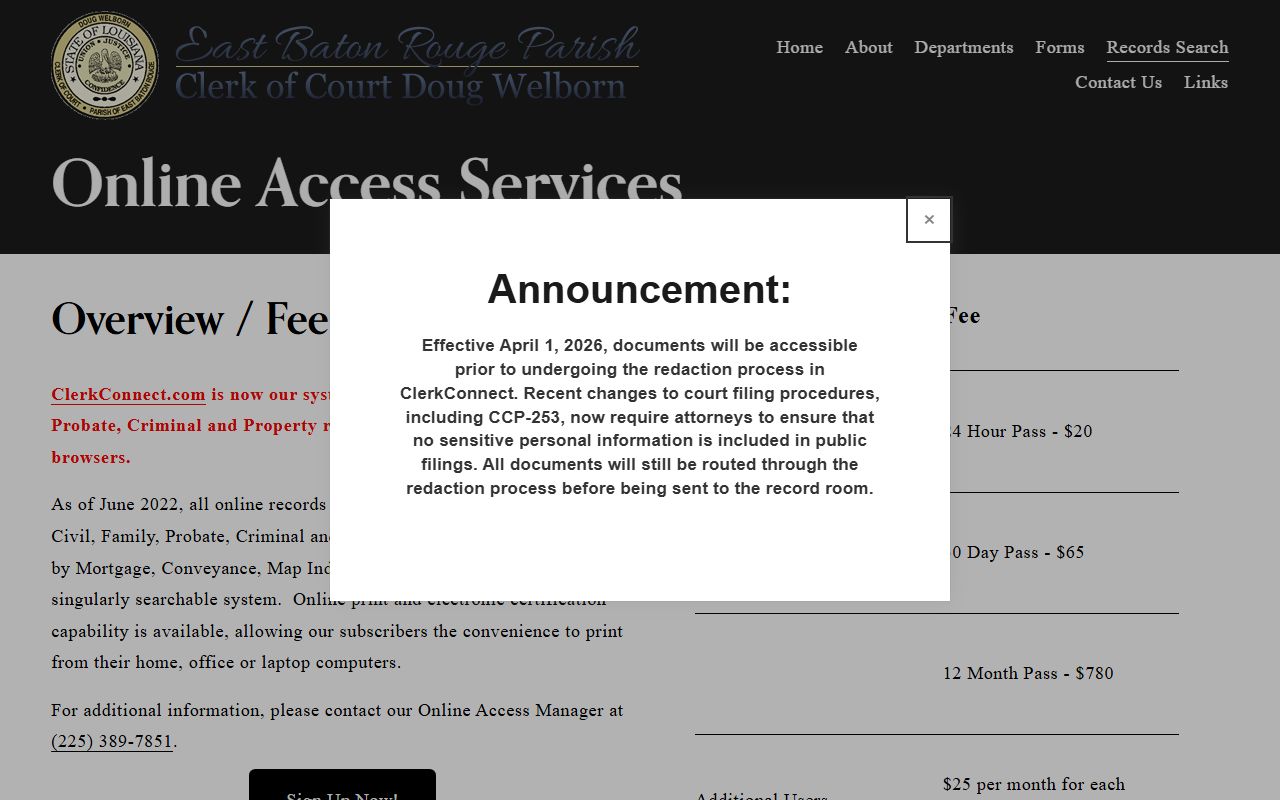
That source matters because a jail roster search may stop at custody status, while Clerk records follow the case as it moves through court.
East Baton Rouge Court Cases
Start with the court side when the question is what charge was filed, whether a charge changed, or what happened in court after the arrest. Start with the jail side when the question is whether the person is still in custody, what booking number is active, or whether a bond amount is being confirmed by the jail. Those two sources can overlap, but they do not answer the same question.
- Open the Clerk Connect route or the court-event inquiry for East Baton Rouge Parish.
- Search by defendant name first. Use a case number if one appears on a bond paper, notice, warrant, or attorney record.
- Open the matching criminal or traffic case and compare the defendant name, filing date, and court event list.
- Read each charge as filed by the court, not just the arrest charge shown at booking.
- Check the status for amendment, dismissal, nolle prosequi, plea, verdict, sentencing, or future court date.
The court-event inquiry is useful when the question is date driven. A person may have a first appearance, arraignment, motion date, probation matter, or warrant recall setting that is not plain from the inmate roster. For full records, including filings and printed copies, use Clerk Connect or the Clerk's in-person inspection process.
| Access route | Best use | Limit |
|---|---|---|
| Clerk Connect | Subscription search and printing for criminal records | Account access is needed for full online use |
| Court Event Inquiry | Finding court dates and events | Not a full case-file substitute |
| Clerk counter | Free inspection and paid copies | Must use Clerk hours and office procedures |
| Baton Rouge City Court | Municipal cases and City Court warrants | Separate from 19th JDC felony case records |
The East Baton Rouge court event inquiry gives a separate public route for event checks.
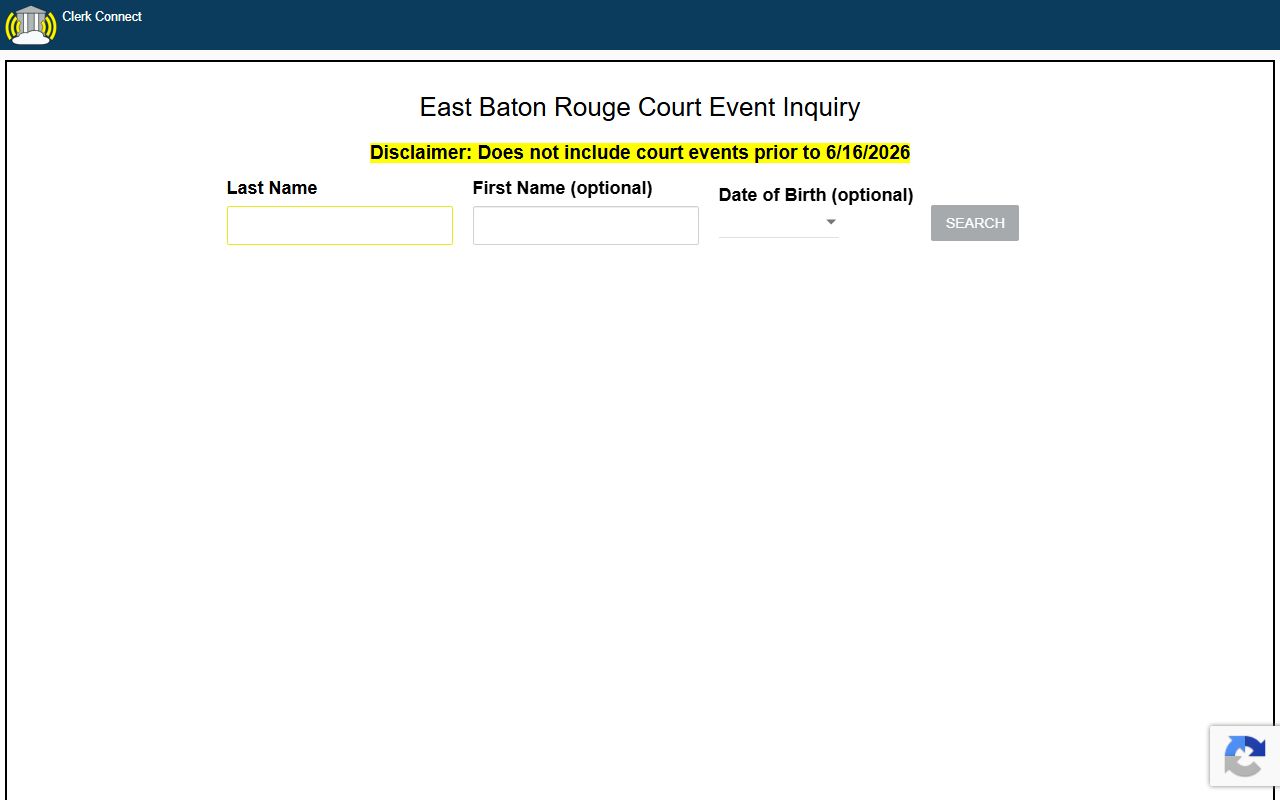
Use event results as a case-timing lead, then confirm the full filed charge and disposition through the Clerk when accuracy matters.
East Baton Rouge Arrest Charges
After an arrest, the prosecutor decides what court charge will be filed. East Baton Rouge Parish District Attorney Hillar C. Moore III serves the 19th Judicial District. The DA's office is the local prosecutor for many parish criminal cases, and the Clerk's criminal records page describes prosecution as a process initiated by the DA's Office and law-enforcement agencies. That means the charge listed at booking may not be the same as the charge that appears in court records after review.
The terms matter. A bill of information is a formal prosecutor-filed charge. An indictment is returned by a grand jury, usually in more serious felony cases. A complaint or affidavit can support the arrest or a warrant and may start early proceedings. Louisiana public-record law also treats bills of information and certain booking summaries as public records, subject to exceptions for investigations, juvenile matters, and other restricted material.
| Complaint | Information | Indictment | |
|---|---|---|---|
| Filed by | Officer, complainant, or prosecutor route | District Attorney | Grand jury |
| Common use | Arrest, warrant, or early case basis | Many felony and misdemeanor prosecutions | Serious felony prosecution |
| Record role | Supports probable cause or case start | States the filed court charge | States the grand-jury charge |
| Why it differs | Based on early facts | Based on prosecutor review | Based on grand-jury action |
The East Baton Rouge District Attorney contact page identifies the prosecutor's office that reviews many arrest files before charges are filed.
DA contact information helps identify the prosecuting office, but case copies and court-event records still come from the Clerk or court system.
East Baton Rouge Charge Status
Court records following an East Baton Rouge Parish arrest can change as the case moves. A charge may start as one offense in the booking record, become a different filed charge in court, then be amended again by plea agreement, motion practice, or prosecutorial review. A status word is not the same as the final outcome. Read the full docket and the most recent event before drawing conclusions.
| Status | What it means |
|---|---|
| Pending | The charge remains open, and the court record should show future or recent events. |
| Amended or reduced | The filed charge changed from an earlier count, often after review, motion, or plea talks. |
| Dismissed | The court ended that count, but other counts or holds may still affect custody. |
| Nolle prosequi | The prosecutor declined to continue that charge. It is often shortened as nolle pros. |
| Disposition | The case has an outcome, such as plea, verdict, dismissal, sentencing, or other final action. |
Louisiana R.S. 44:3 is important here because it recognizes access to some law-enforcement and prosecutive records while also preserving exceptions. It also states that booking records under C.Cr.P. art. 228, summons or citation issuance records, and bills of information are public records. That does not mean every investigative file or juvenile record is open.
East Baton Rouge Bond Records
Bond sits between the jail record and the court record. EBRSO directs people to call 225-308-3400 for bond amounts and charges, and that number is described as available 24 hours a day, 7 days a week. EBRSO Bonding is listed at (225) 358-4005, while Central Booking is listed at (225) 358-4009. Those jail contacts help confirm whether a person can be released, but the bond order itself can be tied to the court case.
Louisiana bond types include cash bond, commercial surety bond through a licensed bail agent, property bond when allowed by the court, release on recognizance, and no-bond or hold situations. A person may have a bond amount on one filed charge but remain in custody because another charge has no bond, a bench warrant is active, a probation or parole hold exists, an ICE detainer is lodged, or state DOC custody is pending.
| Bond type | How it works |
|---|---|
| Cash bond | The full amount is posted according to jail and court instructions. |
| Surety bond | A licensed bail agent posts the undertaking for the defendant. |
| Recognizance | The court releases the person on a promise to appear, when allowed. |
| No-bond hold | Release is blocked until a court or agency clears the hold. |
Always confirm the payee, amount, accepted method, and all holds before posting. The research did not locate a complete EBRSO payment-method table for bonds, so card, cash, or cashier-check rules should not be assumed.
East Baton Rouge Warrant Records
Warrants can create both a jail arrest and a court record. Louisiana C.Cr.P. art. 202 governs arrest-warrant issuance by a magistrate based on a complaint affidavit and probable cause. EBRSO lists a Warrants division at (225) 389-5094. The sheriff's CentralSquare portal includes a warrant route in the application bundle, but the research could not confirm all public columns from a static fetch.
Baton Rouge also publishes a City-Parish open-data table for Baton Rouge City Court warrants. Treat that source as municipal City Court warrant context, not a complete parishwide warrant list. Baton Rouge City Jail temporarily houses people with City Court warrants and people transported for city-court appearances. Bench warrants from the 19th JDC, city warrants, fugitive warrants, and search warrants are different tools.
The City Court Warrants open-data table is useful for municipal warrant research.
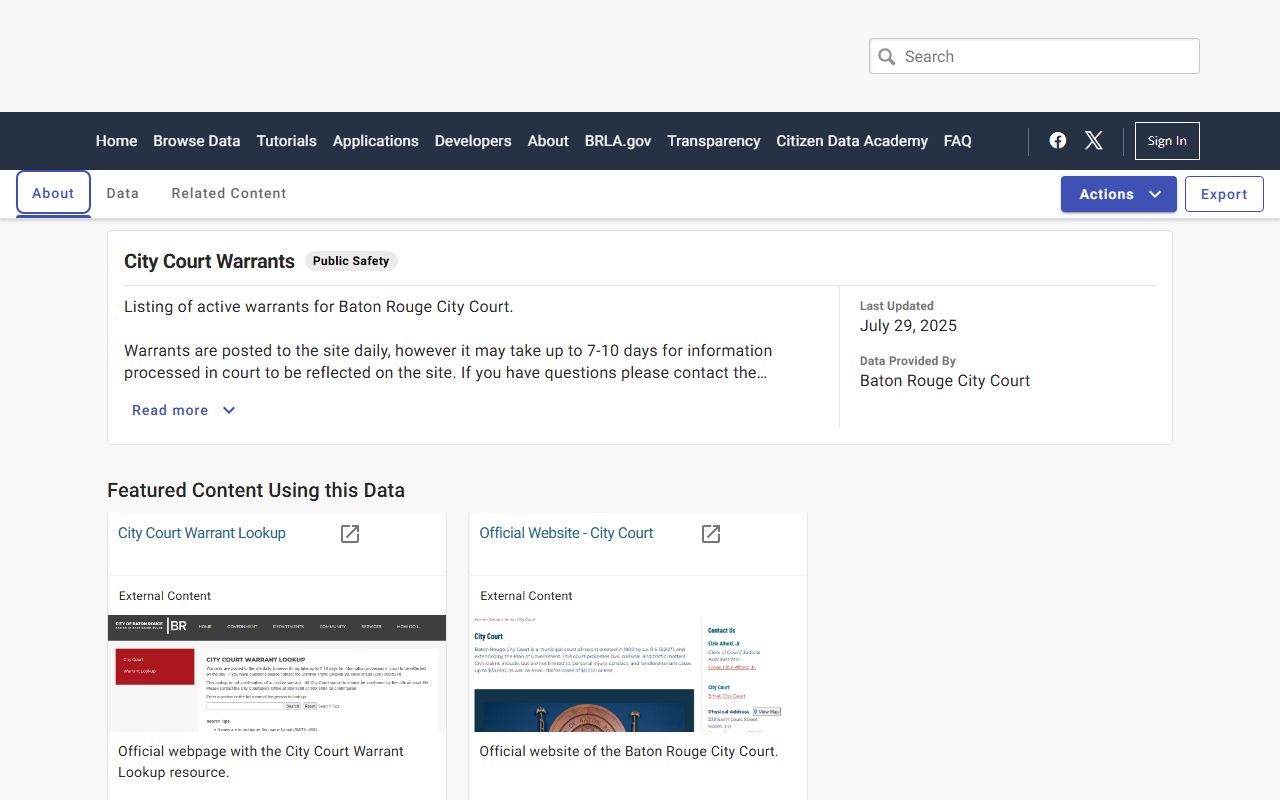
Confirm active warrant status with the issuing court or law-enforcement agency because warrant data can change after recall, arrest, payment, or court appearance.
Charges Versus Convictions
Being arrested, being charged, and being convicted are three different events. An arrest means law enforcement took the person into custody. A filed charge means the prosecutor or grand jury placed an accusation into the court record. A conviction means there was a guilty plea, guilty verdict, or other qualifying adjudication. East Baton Rouge Parish court records after a jail arrest should be read with that timeline in mind.
| Charge | Conviction | |
|---|---|---|
| Stage | Accusation filed in court | Final guilty outcome by plea or verdict |
| Proof level | Based on probable cause and prosecution review | Requires proof beyond a reasonable doubt or a valid plea |
| Can change | Yes, it may be amended, reduced, or dropped | It changes only through later court action |
| Custody effect | May affect bond or holds | May lead to sentencing or DPS&C custody |
Sealed East Baton Rouge Records
Some court records after an arrest are not open to the same degree as an ordinary adult criminal case. Juvenile matters, pending investigative material, sealed records, expunged records, and records affected by specific court orders may be withheld or redacted. Louisiana public-record law gives a broad right to inspect public records through R.S. 44:31, but that right is subject to exceptions and court orders.
Expungement is not the same thing as an acquittal or dismissal. A dismissed case may still have records until a proper expungement or sealing process is completed. Louisiana C.Cr.P. art. 978 governs felony expungement motions in qualifying situations. People seeking to clear or restrict a record should use the court process and legal advice, not a jail roster request alone.
| Sealed | Expunged | |
|---|---|---|
| Public visibility | Hidden from ordinary public access by order | Restricted through the statutory expungement process |
| Government access | May remain available to certain agencies | May remain available in limited legally allowed settings |
| How it happens | Court order or rule for the record type | Motion and court process under Louisiana law |
Background Check Limits
Casual court lookup is not the same as a regulated background check. A name search can find possible court records after a jail arrest, but matching records requires care. Names repeat, dates can be misread, charges can change, and a case may have a later disposition that changes its meaning. For employment, housing, credit, insurance, or tenant screening, use a legally compliant consumer-reporting process.
Important: East Baton Rouge Parish Inmate Population is not a consumer reporting agency and must not be used for FCRA-covered decisions.